Knowing the tools isn’t enough.
Organisations invest heavily in Lean tools, improvement programmes and capability development. Yet many struggle to sustain the gains.
The missing link is often the system around the tools: how leaders manage, how supervisors behave, how frontline teams participate and how improvement becomes part of everyday work.
Understanding the missing link is one thing. Closing it is another. TAKT was built to help organisations do exactly that.
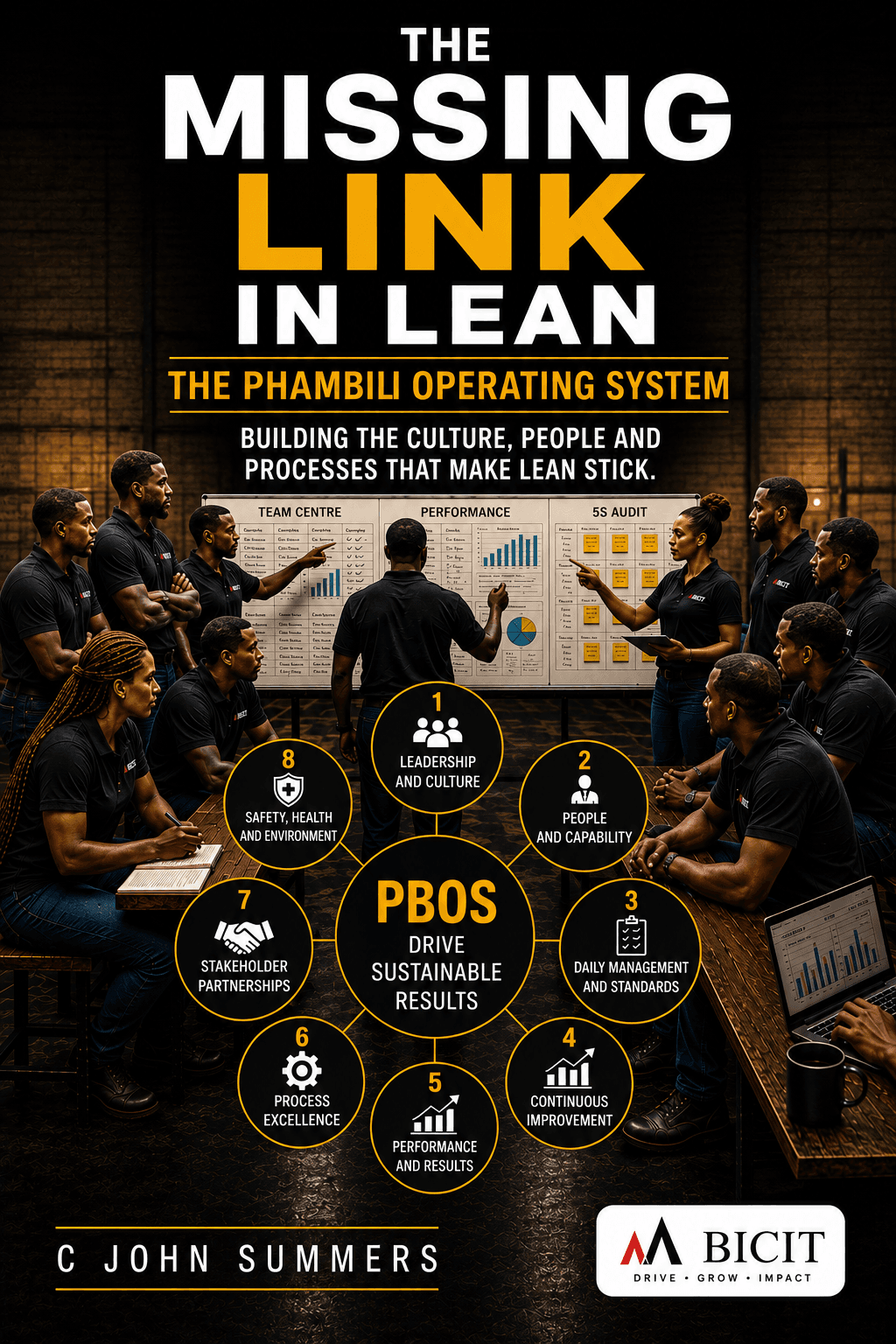
The Missing Link in Lean — The Book
Proposed editorial copy — for author review.
Synopsis
Most manufacturers don’t fail at Lean because they choose the wrong tools — they fail because no one builds the environment those tools need to survive in. After more than 30 years working across manufacturing businesses, including three years leading a full production-system implementation for a shock absorber manufacturer, John Summers identified what was missing: not another Lean technique, but a complete Business Operating System — the way an organisation sets direction, develops its people, measures what matters, and makes problems visible enough to actually solve. The Missing Link in Lean introduces the Phambili Business Operating System (PBOS): eight components, developed and tested in African manufacturing conditions specifically, that create the culture Lean tools need to take root and last.
Who the book is for
Written for both sides of the same transformation — the same two streams TAKT itself is built around. Management & Supervisors: plant managers, production managers and supervisors who set direction, develop people, and are accountable for whether Lean sticks. Shopfloor Workers: TAKT is designed to live on the phone of everyone in the operation, shopfloor included — and the same PBOS language and thinking they encounter daily through the app is what this book explains in full. Reading it reinforces, in their own time, the mindset TAKT is already building on the floor. Especially relevant for leaders and teams operating in African manufacturing contexts, where the book argues systems imported directly from elsewhere often don’t translate without deliberate adaptation.
What the reader will learn
The eight components of PBOS — Vision, Momentum, the Right People, Lean Concepts, Value Stream Mapping, Dashboard & Data, Right Issues, and Reduce Variation — and how to implement them as a connected system, step by step, rather than as isolated initiatives. The book also includes a PBOS self-assessment reference for evaluating where an organisation currently stands.
Key themes
Culture before tools — Lean techniques only work inside an environment built to sustain them. Environment over imitation — a system built for one context rarely transfers unchanged to another; it has to be adapted, not copied. Lasting change over quick wins — the author’s own benchmark for success was that the culture changed, not just the metrics.
Author
C. John Summers has more than 30 years of experience in process improvement across multiple industries. He began his career as a qualified Fitter and Turner before completing a Mechanical Engineering Diploma, later adding a Teachers Diploma, time lecturing at Technical Colleges, and a Business Management Diploma. That combination of manufacturing, education and business experience shaped his approach to organisational transformation and led to the Phambili Business Operating System (PBOS). John is the founder of the thinking behind BICIT and TAKT. About the author.
Buy Now checks out directly through BICIT. External retailer availability is subject to confirmation.
Continue the journey with Book 2: The Missing Middle in Manufacturing →
Buying for your team? See the corporate and team packs.
Find the right starting point.
See TAKT for your operation ↗